
Fine Line Tattoos in Oakville, Toronto & the GTA (2026)
A fine line tattoo is a thin, hair-like line. It is not a size. The same line weight can sit on a collarbone or run from hip to ankle. Most articles only talk about the small one. This guide teaches the style itself: what the needles are, how the work heals, what actually goes wrong, and who you book at Zen Tattoo Studio in Oakville if you want large-scale floral, a full-leg, or a chest and sternum treated as one drawing.
Last updated: August 21, 2026. Reviewed by Austin, co-owner (Austin Furtado), Zen Tattoo Studio, 2342 Lakeshore Rd W, Oakville.
If you already know the scale, book a complimentary consult.
What a fine line tattoo actually is
Fine line is a result: ultra-thin, controlled line that reads like a drawing rather than a bold stamp. The ink still has to sit in the dermis, the same layer as any tattoo. There is just less of it.
That is why it looks clean when it is done well, and why it punishes a shaky hand. A thick traditional line can hide a wobble. A hair-width line cannot. Too shallow, pigment flakes out. Too deep, ink blooms into fat and you get a bruise-shadow. There is almost no spare pigment to cover either mistake.
Fine line is not a smaller tattoo. It is a thinner line on whatever canvas you actually want.
People often assume small means easy. It does not. There is little room for error, which is why this is a specialty chair, not something every artist "does sometimes."
Four things to know before you book
- Fine line describes the line, not the size of the piece.
- "Single needle" is a tool, not a quality grade.
- Thin work needs a specialist whose healed photos still look like fine line, not filtered fresh work.
- Large-scale floral lasts when it is designed with space. Crowded micro-detail is what merges.
If you are still collecting symbols rather than a scale plan, the tattoo ideas for women roundup is useful for themes. It is not a composition.
Fine line vs single needle vs 3RL
These words get used as if they mean the same thing. They do not.
Fine line is the look: ultra-thin, hair-like strokes. Single needle is a tool: one needle, written 1RL. It is the thinnest stroke, the least ink flow, and the least forgiveness. 3RL is three needles grouped tight. It still makes a fine line, with more flow and more control on a long stroke, which matters when a stem has to travel a thigh or a sternum.
A well-handled 3RL can look as thin as a 1RL to the client. Needle count is artist preference, not a price tier. Nobody should charge extra for the words "single needle."
Where artists disagree, they disagree for real. Cora Fick defines "true" fine line by needle diameter, at 0.20 mm or less. Most others define it by grouping, 1RL or 3RL, and by the look of the line. Those are different rulers. They also disagree on how often a true 1RL is even used. Jason Schroeder, speaking in Allure, has said the "single" needle label is technically wrong most of the time. Those two are artist and magazine voices, not medical sources. This studio talks in look and grouping, not a millimetre law. Ask what the line will look like when it is healed.
Fine line vs traditional vs micro-realism
A traditional or bold tattoo uses heavier line, more fill, and more pigment. That extra ink is a cushion. Years later the lines are thicker and softer, but the drawing is still there. Fine line starts thinner, so the same natural spread has less room before two details touch. That is not a reason to avoid the style. It is a reason to design it with space.
Micro-realism is a different job. Packed shading, portraits, and black-and-grey that reads like a photograph are not fine line, even when the edges look sharp on day one. If that is the work you want, you are in a realism chair, not a line chair.
At Zen the match is simple. Fine line floral, script, and large-scale line work: book Oxy. Black-and-grey realism: book Devon, Igor, or Luis. Do not book Igor, Devon, or Luis for fine line. Do not book Oxy for a realism portrait or a packed body suit.
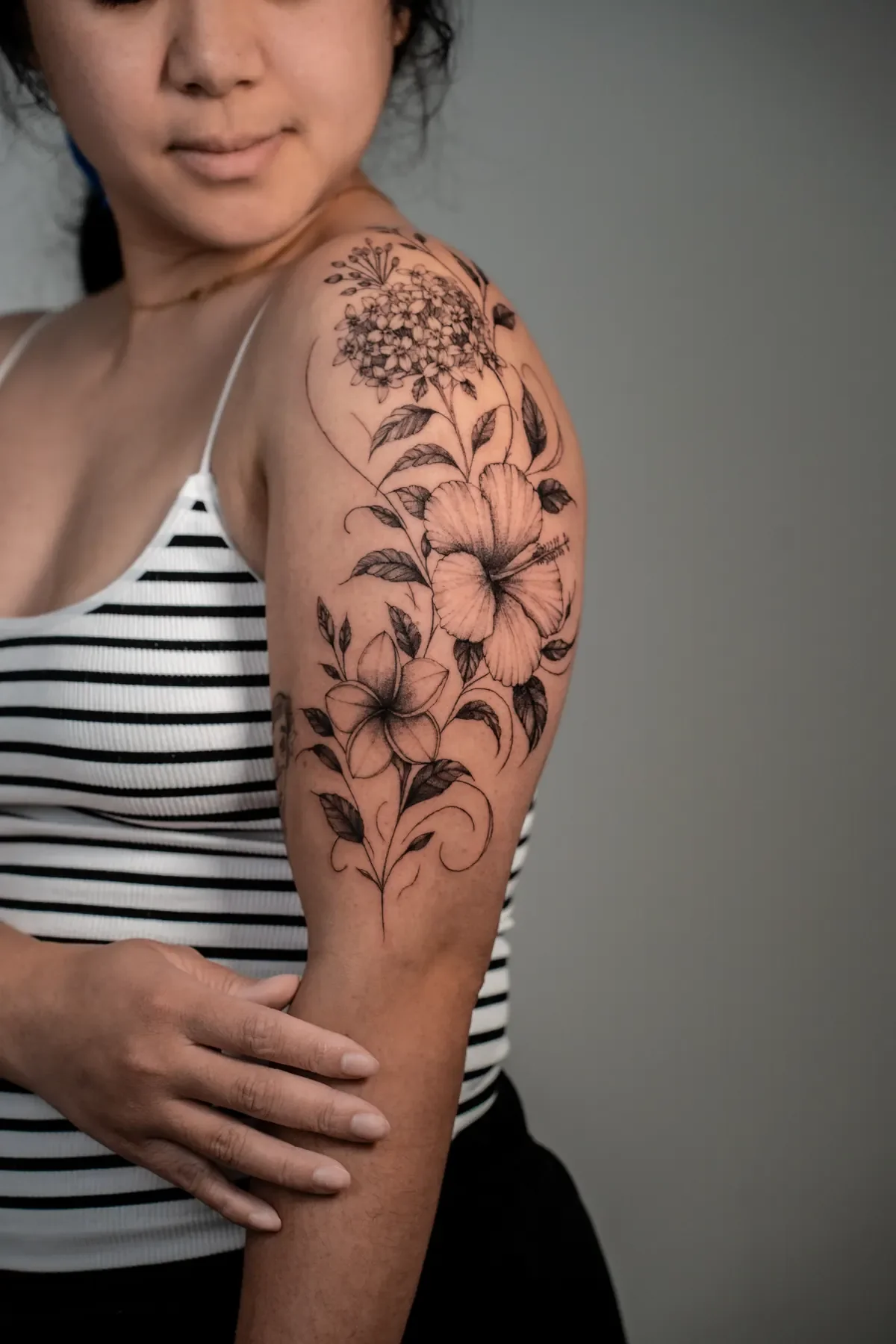
Large-scale fine line is a different craft than tiny flash
Tiny flash is a motif you finish in a short sitting: a small stem, a word, a single bloom. Large-scale fine line is architecture with a lighter hand. The line stays fine. The canvas does not.
That is the work this studio actually sits: florals that travel a torso, hip, or pair of thighs; a full-leg that has to turn from hip to ankle; a chest and sternum treated as one drawing. If you searched fine line tattoo Toronto and landed on walk-in flash, that is the usual result. This article is about the other work.
Scale is how the style lasts. Details large enough, and far enough apart, still read after the skin does what skin does. Lace packed on a two-inch patch merges. A full-leg floral with hero flowers and negative space is not more fragile than a finger script. It is designed against drift.
Floral body work
Peonies, roses, lilies, and ornamental line used as structure, not as stickers. Crowded line on a large field ages badly. There is nowhere for it to go when it softens.
Full-leg projects
Hip to ankle, or a chapter already larger than a "leg piece" off a wall. The design has to turn with the body. It is custom, fitted to your anatomy, and priced as a project in consult. There is no session count you can copy from someone else's thigh.
Chest and sternum as a large composition
A full chest floral, or a sternum that is the spine of a bigger drawing. If the brief is a small collarbone vine, a discreet underboob motif, or a single sternum bloom, that lives on the female chest fine line and floral ideas page.
A body suit is a different brief: continuous coverage, usually black-and-grey realism. Read the full body suit tattoos for women guide if that is the project.
How fine line heals (and why it looks different from bold work)
Getting a tattoo breaks the skin. Mayo Clinic puts typical surface healing at about two weeks. That is the scab-and-flake window most people mean when they say "healed." It is not the whole story.
Cleveland Clinic treats tattoos as controlled trauma. Healing depends on size and location. Larger tattoos can take a few months. Chest and back work is slower than a small wrist. Around two months the top layer is typically settled; deeper layers can take several more months. A full-leg or chest-sternum floral is not done when the surface stops flaking. Plan clothes, sleep, sweat, and the next sitting around that longer clock.
The first weeks look ordinary if it is not infection: itching, flaking, scabs, a little blood-and-ink ooze, sore red skin (Cleveland). The American Academy of Dermatology describes the same picture: redness, swelling, clear fluid, then itch, flake, and scab.
Fine line often looks different from bold work in that window. There is less pigment, so the line can go gray, dull, or milky when the top layer clouds. Artists who teach this style call that a settle, not a failure. It is studio education, not a Mayo Clinic finding. The wet-ink sharpness you photograph on day three is not the final tattoo. Do not pick. Do not drown it in ointment. A line kept too wet can blur in the heal. That blur is aftercare, not a blowout.
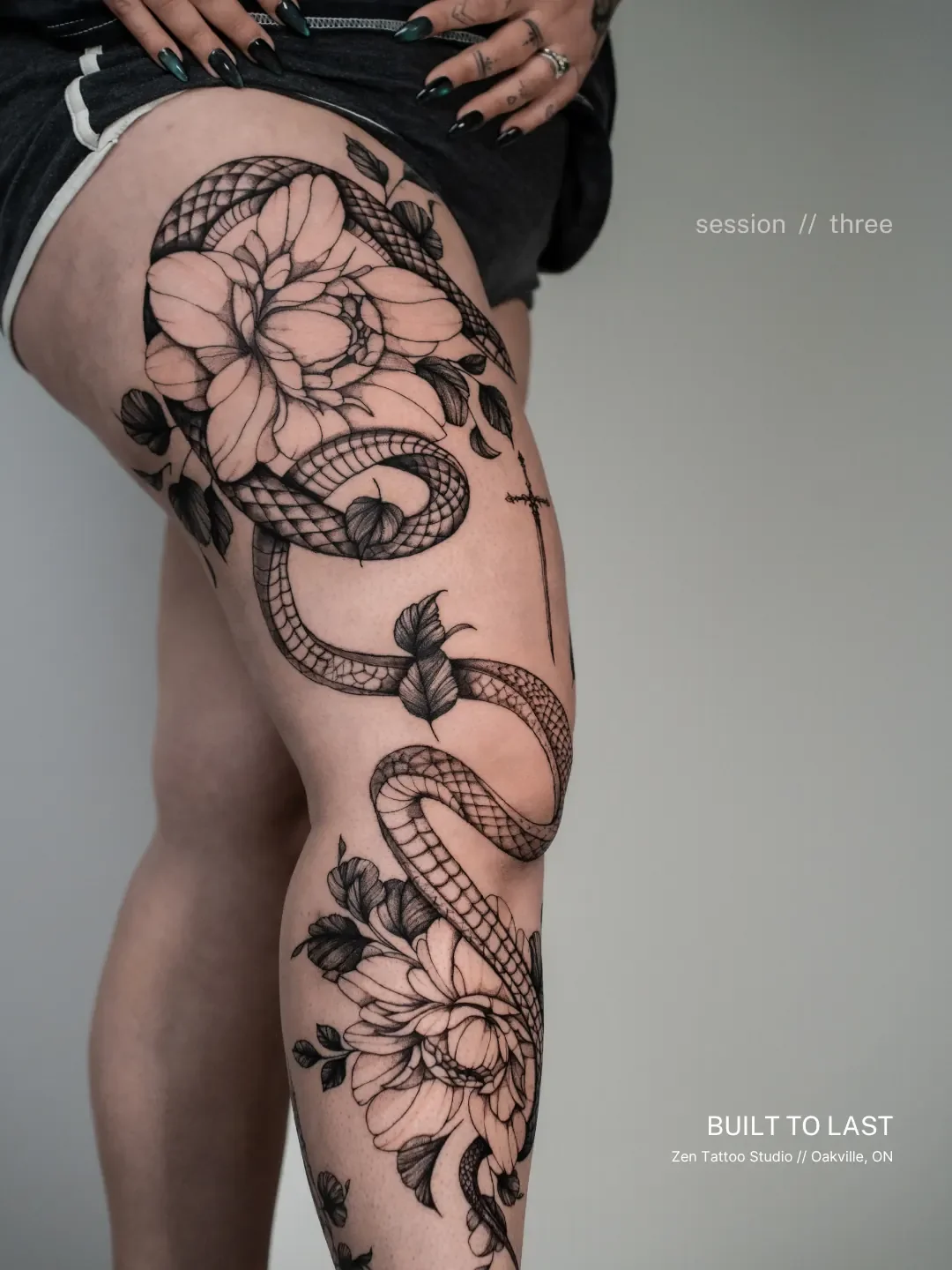
Fade, drift, and blowout are three different problems
Clients mash these together. They are not the same.
Blowout is technique. The needle went too deep. Ink sat in fat instead of dermis. You get a fuzzy bruise-shadow around a line, often as soon as the swelling drops. It can worsen. A specialist with a light, consistent hand is how you avoid it. You cannot wash a blowout out.
Ink drift is biology. Every tattoo widens a little as immune cells work on the pigment. Fine line has less margin, so two petals drawn too close can start to read as one shape years later. Spacing is the design answer, not a cream.
Fade is density loss. Sun is the usual driver. Shallow placement is the other. UV light can fade some tattoo inks; that is the AAD, not folklore.
A fourth problem shows up in the heal: blurring from a line that sat too wet or under a heavy occlusive. If a line looks soft, ask which of those you are looking at. The fix is different for each.
What it looks like in 5 years (and 10)
There is no honest single picture. Anyone who says fine line "ages best" or "is gone in two years" is selling a side.
A well-placed piece with room in the drawing usually looks like a softer version of the healed tattoo: charcoal rather than wet black, edges still crisp if it had space. High-sun zones lighten first. A protected piece can still read as a drawing years out, softer and grayer. A crowded micro-piece in the same sun can look like a smudge. Some fine line is decades old: soft and gray, still defined. That is the target, not Instagram sharpness.
What decides it: design, placement, sun, and a specialist with healed photos. Hands, fingers, feet, and palms are the wrong canvas for ultra-fine work if you want it to still say what it said. Put the fine work on a thigh, a calf you will sunscreen, a torso, or a chest you will keep out of a tanning bed.
Who should wait, or pick another style: someone who wants a first tiny finger script and thinks a full-leg floral is the same product; someone who will not wear sunscreen; someone who wants a packed portrait. That last brief is realism.
Pain, placement, and which areas hold detail
Placement rules pain more than style. Fine line often means a smaller grouping and a lighter hand, so many people feel less surface trauma than a packed colour day. Ribs, sternum, and inner wrist still sting. The needle is still a needle.
Tougher for most people: ribs, chest, sternum, inner arm, inner thigh, spine. Easier: outer arm, outer thigh, outer calf, shoulder. Pain is personal. This article does not give medical or numbing advice. For a placement-by-placement breakdown, use the tattoo pain chart.
What holds detail at scale is a different list than what feels easy. Outer thigh and outer calf take a full-leg floral well if you protect them from sun. A large chest-sternum composition will hurt more and take longer to heal than an outer arm, which is why Cleveland's note about chest and back work matters here. What helps on a full day is ordinary: sleep, food, hydration, and an artist who will pause.
Aftercare for thin lines
Follow the sheet your artist hands you. The medical baseline is Mayo Clinic, Cleveland Clinic, and the American Academy of Dermatology.
First night
- The artist typically applies ointment and a clear bandage. Follow their cover time (Cleveland Clinic: at least three hours or more).
- Wash your hands before you take the bandage off. Soak the bandage in warm water and peel it gently.
- Do not pick.
First two weeks
- Wash twice a day, gentle touch. Pat dry. Do not rub (Mayo Clinic).
- Mild fragrance-free soap. Warm, not hot, water. A clean paper towel (Cleveland Clinic).
- Mild moisturizer. Moisturize twice a day so the skin does not crack.
- No sun until it heals. No swimming (pools, hot tubs, rivers, lakes). No clothing that sticks (Mayo Clinic).
- Until it is healed: skip petrolatum, sunscreen on open skin, and soaking. Petrolatum can block pores (Cleveland Clinic).
- Normal: redness, swelling, clear fluid, then itch, flake, and scab (AAD).
- Fine-line note (studio education, not a clinic finding): do not drown the line in ointment. A line kept too wet can blur in the heal.
Once it is healed
- Water-based lotion if dry. Petroleum-based products can fade ink (AAD).
- Broad-spectrum, water-resistant SPF 30 or more, 15 minutes before you go out, reapply at least every two hours. No tanning beds (AAD).
- See a dermatologist if tattooed skin is changing.
- Infection is not a normal heal. Open sores, or a reaction lasting longer than one to two weeks, mean a doctor (AAD). Cleveland Clinic: fever, skin hot to the touch, odor or heavy drainage, pain that increases, red streaks or spreading redness.
- Shop safety (Mayo Clinic): licensed studio, fresh gloves, sealed needles, single-use ink cups, autoclave. No DIY kits.
Touch-ups: the 8-week check and the years-later refresh
"Touch-up" is two appointments that get the same word. The first is a heal check, often around eight weeks, once fallout is visible. Fine line is more likely to need that first pass because there is less pigment to begin with. That is maintenance, not a failure. The second is a refresh years later, when sun or drift has softened a line you still want sharp. Frequency depends on placement, sun, and how fine the line was. Not one number.
How the styles compare
This is a style map, not a price list. Cost lives in consult because the drawing is custom.
| Fine line at Zen | Bold / traditional | Black-and-grey realism at Zen | |
|---|---|---|---|
| What it looks like | Thin, hair-like line. Floral and botanical work at body scale. Negative space is part of the drawing. | Heavy outlines, high-contrast fill, classic motifs. Reads from across a room. | Packed tone, portraits, wildlife, sculpture. Reads as form and shadow, not as a thin line. |
| How it heals | Less pigment, so the gray or milky settle is easier to see. Surface healing is often around two weeks. A large chest or leg can take months underneath. | More ink, so the same heal looks denser. Lines stay thick as they soften. | Same medical timeline, more surface to care for. Packed sessions are a bigger wound on a big field. |
| Who you book | Oxy only. Do not book a realism chair for this style. | A different job than fine line or realism. Ask in consult if that is even the right room. | Devon, Igor, or Luis. Pick from healed work. None of them is the only option. |
| How a project starts | Complimentary consult. Custom design on the body. A full project price, not a menu or an hourly clock. | Often a drawn sheet or flash, frequently one sitting. | Complimentary consult. Coverage and composition first, then a quote for the project. |
Who to book
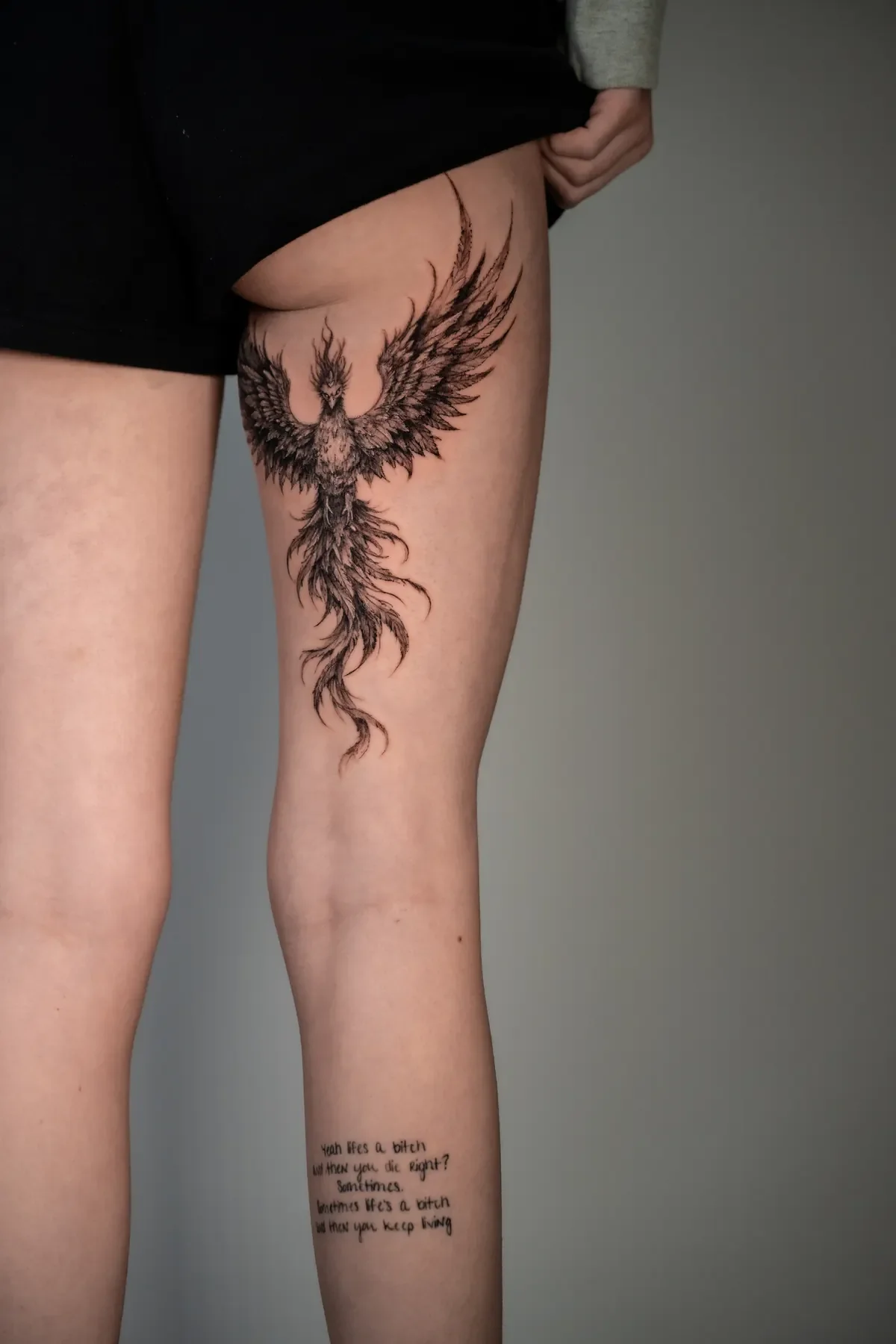
Book Oxy for fine line. That is the chair: large-scale floral, full-leg, chest and sternum, and the finer end of script and botanical work. If you want that scale after a fine line tattoo Toronto search, book Oxy here in Oakville.
Do not book Igor, Devon, or Luis for fine line. They are realism artists.
If the work is black-and-grey realism (portraits, packed sleeves, wildlife, a body suit), you have three artists: Devon, Igor, or Luis. Read each page and pick the hand that matches the images you want. None of them is "the" realism artist. Igor is not the only option, and he is not the fine-line option.
The artists roster is the full Oakville list if you are still matching a name to a job. Ask for healed work in the style you want.
How a large floral, full-leg, or chest-sternum project is planned
This is not an hourly flash appointment. You sit a complimentary, in-depth consult. You talk scale, placement, existing ink, and how you live in the skin. The artist maps the body first: where the hero flowers sit, where the drawing needs to breathe, how a line turns a knee or a sternum.
All designs are custom. From the unique design that fits your body, they give you an accurate session idea and a full project price. Sessions vary. The artists work quickly without sacrificing quality.
Oxy's typical rate is $1,000–$1,200 per day, not hourly. One number on a blog is not your invoice. A full-leg or body-scale floral is designed, then quoted as a whole in that consult. If you already have references, start at plan your tattoo, then book. Payment plans exist for larger work. They are a conversation, not a reason to skip the consult.
Most results for a fine line tattoo Toronto query are flash lists. The consult is complimentary. Let that conversation sell the work, or tell you it should be a different style.
Book a complimentary consult. Ask for Oxy if the work is fine line. Ask for Devon, Igor, or Luis if the work is realism.
FAQ
What is a fine line tattoo?
A fine line tattoo is an ultra-thin, hair-like line that reads like a drawing rather than a bold stamp. It is a line weight, not a size. The same style can be a small collarbone motif or a full-leg floral. The ink still sits in the dermis. There is just less of it, which is why a specialist matters.
Is fine line the same as single needle? What do 1RL and 3RL mean?
No. Fine line is the look. Single needle is a tool: one needle, written 1RL. 3RL is three needles grouped tight, and a good 3RL can look as thin as a 1RL. Needle count is mostly artist preference, not a quality grade. Cora Fick (artist, 0.20 mm) and Jason Schroeder in Allure (the "single" needle label is technically wrong most of the time) are artist and magazine voices, not medical sources. This studio talks in look and grouping, not a millimetre law.
How do fine line tattoos heal, and how long until a large piece is fully healed?
Fine line heals through the same stages as any tattoo: redness, swelling, clear fluid or a little blood-and-ink ooze, then itch, flake, and scab. Mayo Clinic puts typical surface healing at about two weeks. Cleveland Clinic says larger tattoos, and work on the chest or back, can take months for the deeper layers. Thin work often looks gray or milky while the top layer settles. That dull phase is artist education, not a Mayo Clinic finding, and it is not a blowout.
Do fine line tattoos fade? What is the difference between fade, drift, and a blowout?
They are three different problems. Fade is pigment looking lighter, usually from sun or a line that sat too shallow. Drift is biology: every tattoo widens a little, and thin details drawn too close can merge. A blowout is technique. The needle went too deep and ink bloomed into fat, leaving a fuzzy bruise-shadow. A line that sat too wet in the heal can also blur. That is aftercare, not a blowout.
How will a fine line tattoo look in 5 years?
There is no honest single picture. A well-designed, well-placed piece that sees sunscreen is often still a readable drawing at five years: softer, a bit grayer, structure intact. A crowded micro-piece on a high-friction or high-sun zone can look like a smudge. Hands, fingers, feet, and palms are the wrong canvas for ultra-fine work if you want it to still say what it said. Nobody should promise it ages best or that it will be gone.
Who should I book at Zen Tattoo Studio for fine line versus black-and-grey realism?
Book Oxy for fine line. Do not book Igor, Devon, or Luis for fine line. If you want black-and-grey realism (portraits, packed sleeves, wildlife, a body suit), you have three artists: Devon, Igor, or Luis. Igor is not the only realism option, and he is not the fine-line option. A fine line tattoo Toronto search should lead you to a specialist. Zen Tattoo Studio is at 2342 Lakeshore Rd W, Oakville, and books this work by complimentary consult.
How much does a large-scale fine line tattoo cost at Zen?
There is no sticker price for a full-leg or a body-scale floral. The studio designs the piece to your body and gives a full project price in a complimentary consult. Work is not priced per hour. Oxy's typical rate is $1,000–$1,200 per day. Sessions vary. That day rate is a planning number, not your invoice.
How many sessions will a full-leg or large chest composition take?
Every design is custom. The studio gives an accurate session idea from the unique design that fits your body, and they cover that in a complimentary in-depth consult. Sessions vary. The artists work quickly without sacrificing quality. There is no honest session count you can copy from someone else's thigh.
Related reading
- Oxy at Zen: the fine-line chair for large floral, full-leg, and chest-sternum work.
- Meet the artists: the full Oakville roster so you can match a name to a job.
- Devon: one of three black-and-grey realism chairs, not a fine-line booking.
- Igor Kizyma: realism (sleeves, backs, suits). Do not book him for fine line.
- Luis Fernandes: realism (portraits, animals, large panels). Same rule: not the fine-line chair.
- Female chest: fine line + floral ideas: smaller collarbone, sternum, and underboob compositions, not this article's scale.
- Full body suit tattoos for women: continuous coverage and realism body suits, a different chair and a different plan.
- Tattoo pain chart: placement-by-placement sting, because location rules pain more than style.
- Tattoo ideas for women: themes and symbols, not a large-scale fine-line plan.
- Plan your tattoo: bring references and start the consult map.
- Book a complimentary consult: the only honest next step for a full-leg or body-scale floral.
Serving Oakville, Toronto, Mississauga, Burlington, and the GTA from 2342 Lakeshore Rd W, Oakville.
