
Dragon and Koi Tattoo Meaning in Oakville, Toronto & the GTA
A dragon and koi tattoo is usually one story told in two bodies: the carp that fights the current, and the dragon that story becomes. This page teaches dragon and koi tattoo meaning as East Asian folklore and Japanese tattoo tradition actually use it, what people worry about before they book, how large black-and-grey work heals, and who you sit with at Zen Tattoo Studio in Oakville when the piece is a sleeve or body chapter, not a tiny flash sticker.
Last updated: September 3, 2026. Reviewed by Austin Furtado, co-owner, Zen Tattoo Studio, 2342 Lakeshore Rd W, Oakville. Serving Toronto and the GTA.
If you already know the scale and the chair, book a complimentary consult.
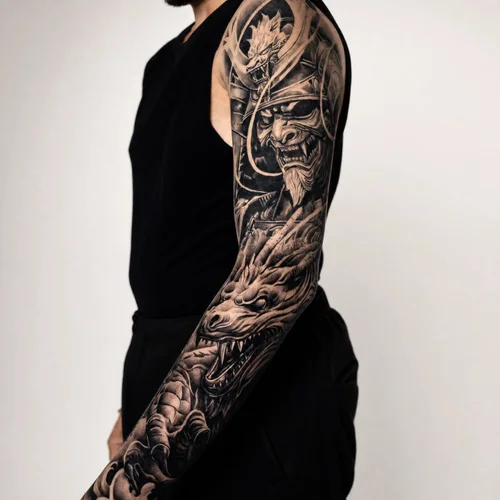
What dragon tattoo meaning is (Eastern vs Western)
There is no single global meaning for a dragon tattoo. The useful split is cultural.
East Asian dragons (Chinese lóng, Japanese ryū) are typically long, serpentine, and often shown without bat wings. In Chinese and Japanese visual tradition they are tied to water, rain, weather, wisdom, protection, and auspicious authority. You honor the dragon more often than you slay it. In Japanese irezumi, the ryū is a classic large motif that wraps the body with clouds, waves, and wind bars. Ranking educators and studio guides agree on this East/West contrast (spiritualanimals, Hon Tattoo, HowStuffWorks).
Western dragons draw from medieval European and fantasy imagery: winged, fire-breathing, territorial. The tattoo read is often conquest, power you fought, or a force you had to master. Same word. Different animal.
Neither tradition is a medical fact. Both are inherited stories. At a luxury black-and-grey realism studio in Oakville, most dragon chapters clients bring are Eastern or Japanese-inspired in silhouette (whiskers, scales, water, clouds), even when the personal meaning is modern: protection, discipline, a hard-won role at work or at home.
Label the culture. Do not invent a clinic rule. Your meaning still has to fit the drawing and the body.
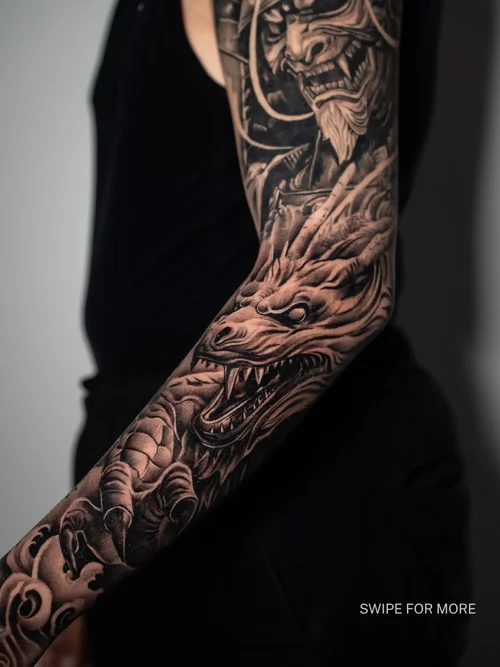
What koi tattoo meaning is
A koi tattoo, in the Japanese and Chinese lore people actually cite, means perseverance against resistance. The fish is not a lucky charm that does the work for you. It is the creature that keeps swimming when the current does not cooperate.
The Dragon Gate legend (verified folklore, not invented studio lore)
The story originates in Chinese mythology around a waterfall associated with the Yellow River, known as the Dragon Gate (Longmen in Chinese, Ryumon in Japanese). Carp gather and try to leap the falls. Almost all fail. Legend says any carp stubborn enough to climb the whole gate is transformed into a dragon. The tale moved into Japanese culture along older exchange routes and became a visual staple in painting, warrior ethics, and later irezumi (Sukaizen, japaneserituals.com).
Japanese still uses the idiom toryumon (登竜門), “climbing the dragon gate,” for an exam, audition, or first break that turns an unknown into somebody. That is culture, not a tattoo sales pitch.
Direction and color (use carefully)
It is widely said that a koi swimming upstream (nobori-goi) means a struggle still in progress, and downstream (kudari-goi) means the obstacle is already behind you. That reading is coherent and many artists use it. Careful cultural writers note it is largely a modern convention. Traditional Japanese tattooing often chose direction for composition and body flow first (japaneserituals.com). If direction matters to your story, say so in consult. Do not let a shop invent a forbidden orientation.
Popular color charts (black = hardship, red = courage/love, gold = prosperity, blue = calm) mix Japanese associations with a later feng shui / Western popular layer. Enjoy them if they help you talk. Do not treat them as ancient law. At Zen, many large Japanese-inspired chapters are black-and-grey so contrast and water hold for decades. Color is a design choice, not a requirement for the meaning to land.
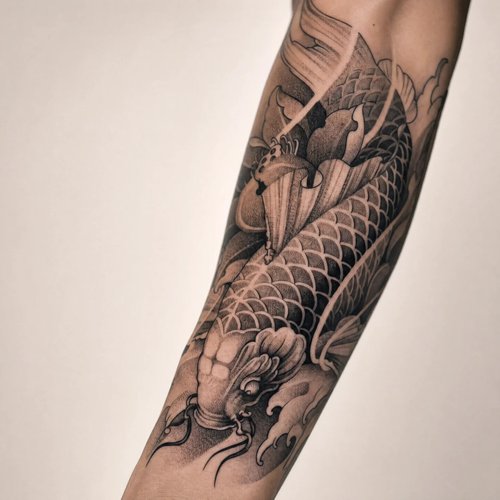
Dragon and koi together (why they pair in Japanese sleeves)
When dragon and koi appear on the same body, they are rarely two random animals. In the Dragon Gate story they are one being at two moments: the applicant in the water and the destination in the clouds (japaneserituals.com, Sukaizen).
That is why Japanese-style sleeves and back pieces so often place:
- Koi lower (forearm, calf, lower back) in churning water
- Transition or waterfall through the joint or mid-torso
- Dragon higher (shoulder, upper back, chest) with clouds and authority
The composition reads bottom to top as struggle → breakthrough → earned power. People book the pair after a recovery, a career climb, a family chapter, or a long private grind they do not want to explain in words. The tattoo can carry the arc without a caption.
This page owns meaning. If you are still choosing a visual language (Japanese-inspired realism vs bold graphic vs thin line), start with the tattoo styles compared map. That page is the style menu. This page is the dragon and koi story.
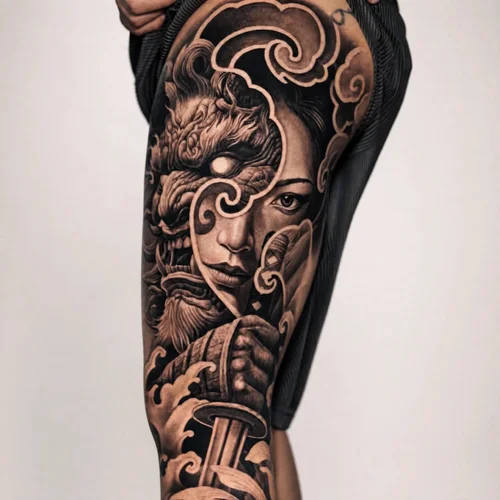
Four things to know before you book
- Dragon alone, koi alone, and dragon+koi are different briefs. Say which story you want. Pairing them is the full transformation arc. One motif alone is still valid.
- East Asian symbolism is culture, not a clinic. We design with respect for the visual tradition. We do not sell you a fake “forbidden” rule.
- Scale is part of the meaning. Tiny flash koi or dragons lose scale texture, water, and narrative first. Sleeves, thighs, backs, and chest panels are the natural canvas for this lore.
- Style picks the chair. Packed black-and-grey realism (this house lane) is Devon, Igor, or Luis. Fine-line floral is a different job. Do not book Oxy for packed realism dragon/koi.
What people worry about
Cultural respect. Fair. The Dragon Gate story and Japanese sleeve grammar are not props. Come ready to talk about what the symbols mean to you. We design custom work that fits the body. We do not copy a random Instagram stencil and call it tradition.
Cliche or “too common.” Koi and dragons are classic for a reason. A cliche is usually a small, generic flash on a high-wear spot. A custom chapter with real water, scale, and anatomy does not read as a sticker.
Yakuza or “too Japanese for me.” Irezumi has a complex social history in Japan. A GTA client booking a Japanese-inspired sleeve is not automatically claiming that history. Still, if you are uneasy, say so. The consult is where we match motif, scale, and intent.
Aging. Soft grey clouds, thin whiskers, and tiny scales go first if the piece is undersized or low-contrast. That is a specialist problem, not a reason to skip the symbol.
Pain and sessions. Large black-and-grey sleeves and body chapters are multi-session work. Meaning does not change the physics. Plan the body chapter, then heal between sits.
Wrong chair. Fine-line floral artists are excellent at their lane. Packed realism dragons and koi are a different skill set (density, skin breaks, water, contrast). Book the realism chair.
Comparison table (educational, not prices)
This table is a map. Your project is quoted in a complimentary consult. No sticker menu.
| Look | Meaning fit | How it tends to age | Zen chair (Oakville) |
|---|---|---|---|
| Dragon alone (large B&G) | Protection, wisdom, authority, Eastern water dragon energy (or Western conquest if that is the drawing) | Holds when contrast, skin breaks, and scale are designed in | Devon, Igor, or Luis |
| Koi alone (large B&G) | Perseverance, upstream effort, a specific hardship you came through | Holds when water and fish have room; tiny fins fail first | Devon, Igor, or Luis |
| Dragon + koi sleeve / body chapter | Full Dragon Gate arc: struggle and earned transformation in one piece | Best aging when treated as one composition across the limb or torso | Devon, Igor, or Luis (example sleeve language often sits with Devon / @Devinkz) |
| Tiny flash dragon or koi | A reminder you can hide. Weak room for the full story | High wear. Fine detail and water go first | Not the work this page is for. Say it in consult if that is all you want |
How large black-and-grey Japanese-realism heals
Large sleeves and body chapters heal on the same principles as any tattoo. The difference is surface area and session count. Ink is placed in the dermis with needles (Mayo Clinic). Cleveland Clinic describes tattooing as controlled trauma that needs support to heal (Cleveland Clinic). Follow the sheet your Zen artist hands you. The notes below are general education, not a substitute for that sheet or for a doctor.
First night
Your artist will cover the fresh work as they direct (often a protective film or bandage). Keep it clean. Wash your hands before you touch it. Mild weeping of plasma and ink tint can be normal early on (Cleveland Clinic). Do not soak the piece. Do not sleep in dirty gym clothes stuck to the skin. Mayo advises clothing that will not stick to a new tattoo (Mayo Clinic).
First two weeks
Mayo notes most tattoos take about two weeks to heal at the surface, with gentle washing twice a day, mild moisturizer, no sun, and no swimming in pools, hot tubs, rivers, or lakes (Mayo Clinic). Cleveland Clinic adds: mild fragrance-free soap, pat dry (do not rub), loose breathable clothes, and expect itching, flaking, and possible light scabbing in the first weeks. Do not pick (Cleveland Clinic). Larger pieces can stay red or swollen longer than a small wrist tattoo.
Infection is not a normal heal. Fever, skin that feels hot, odor or significant drainage, pain that increases, or red streaks spreading from the site mean you contact a healthcare professional (Cleveland Clinic; Mayo Clinic).
Once healed
When the top layer has settled, long-term care matters for black-and-grey contrast. The American Academy of Dermatology recommends water-based lotion or cream if tattooed skin feels dry, broad-spectrum water-resistant SPF 30 or more in the sun, and staying out of tanning beds. Petroleum-based products can fade ink. See a board-certified dermatologist if the skin reacts or changes (AAD).
Deeper layers can keep remodeling for months after a large sleeve. That is why we plan sessions and aftercare like a project, not a walk-in.
Who to book in Oakville
Zen Tattoo Studio specializes in luxury black-and-grey realism. For packed dragon, koi, or dragon+koi sleeves and body chapters, the realism chairs are:
- Devon (@Devinkz). Strong fit for large custom narrative sleeves.
- Igor. Large-scale black-and-grey realism.
- Luis. Black-and-grey realism, large compositions.
Read the artists roster and pick from healed work. None of them is “the only” realism option.
Oxy is not the chair for this work. She is the fine-line floral specialist. Do not book Oxy for packed realism dragon/koi. Do not book Devon, Igor, or Luis for a fine-line floral job.
If you already have references, start at plan your tattoo.
Book the consult
A meaning page cannot quote your sleeve. Zen Tattoo Studio at 2342 Lakeshore Rd W, Oakville, will look at your references, your body, and the chair, then shape the project in a complimentary consult. No price menu. No day-rate sticker. Bring one sentence of meaning if you want it in the drawing. Bring healed style references, not only a cartoon koi.
Related reading
- Tattoo styles compared: the style map. Use it when you are still choosing a visual language. This page owns dragon/koi meaning, not a second styles rewrite.
- Butterfly tattoo meaning in Oakville: another meaning educator if transformation is your theme but the insect is the metaphor.
- Devon: one of three black-and-grey realism chairs. Useful if the sleeve example language above matches what you want.
- Artists: full Oakville roster so you can match a name to healed work.
- Plan your tattoo: how a large custom project starts at Zen.
- Booking: complimentary consult form.
FAQ
What does a dragon and koi tattoo mean together?
Together they usually tell the Dragon Gate story: the koi’s perseverance and the dragon as the earned result. You are wearing struggle and transformation as one narrative, which is why Japanese-style sleeves place koi lower in water and the dragon higher in clouds. Zen Tattoo Studio in Oakville designs that arc as custom black-and-grey realism, not as two stickers.
What does a dragon tattoo mean in Eastern vs Western tradition?
Eastern dragons (Chinese and Japanese traditions) are often read as wisdom, protection, water, and auspicious power. Western dragons are more often read as adversaries, fire, and conquest. At Zen in Oakville, most large dragon chapters clients request follow an Eastern or Japanese-inspired silhouette. Say which tradition you mean in consult.
What does a koi tattoo mean on its own?
Perseverance through hardship. The classical lore is the carp that keeps leaping the Dragon Gate until it becomes a dragon. Many people mark a specific difficulty they came through. Direction (upstream vs downstream) can refine that story, but treat it as a modern reading unless your artist builds it into the composition on purpose.
Why do Japanese sleeves pair dragon and koi?
Because folklore already pairs them as one life story. The composition lets the body read bottom-to-top: effort, breakthrough, mastery. That narrative needs sleeve, thigh, back, or chest scale. Tiny flash rarely holds the water and the scales.
Who should I book at Zen Tattoo Studio in Oakville for a dragon or koi sleeve?
Book Devon, Igor, or Luis for black-and-grey realism. The sleeve example language on this page aligns with Devon (@Devinkz). Do not book Oxy for packed realism dragon/koi. She is the fine-line floral chair. Start with a complimentary consult serving Oakville, Toronto, and the GTA.
How does a large black-and-grey dragon or koi tattoo heal?
Surface healing is often about two weeks with gentle washing, moisturizer, no sun, and no swimming (Mayo Clinic). Expect flaking and itching in the early weeks and do not pick (Cleveland Clinic). Once healed, use water-based lotion if dry and SPF 30+ in the sun (AAD). Large chapters take longer and need session planning. Follow your Zen artist’s sheet.
Is a tiny dragon or koi flash a bad idea?
It is a different job. Tiny work has less room for scale, water, and the full Dragon Gate story, and high-wear spots age faster. This Oakville educator page is written for large custom chapters. If a small reminder is all you want, say that honestly in consult.
Does Zen Tattoo Studio in Oakville quote dragon and koi work from a price menu?
No. Large custom black-and-grey projects are scoped in a complimentary consult. Bring references and placement. We match you to Devon, Igor, or Luis and build the piece to your body. Serving Toronto and the GTA from 2342 Lakeshore Rd W, Oakville.
