
What Happens at a Tattoo Consultation in Oakville
A tattoo consultation is a free planning conversation, not a tattoo. At Zen Tattoo Studio in Oakville you talk with co-owner Austin or Dante, by phone for about 10 to 15 minutes or in the studio for about 35 to 45 minutes. You leave knowing which artist fits your idea, how many sittings it may take, and the full pricing for your project.
This page walks through what happens at a tattoo consultation at Zen, step by step. When you are ready, book a free consultation.
Reviewed by Austin, co-owner. Studio input from Dante, co-owner. Last updated: October 16, 2026. Zen Tattoo Studio, 2342 Lakeshore Rd W, Oakville. Serving Oakville, Toronto, and the GTA.
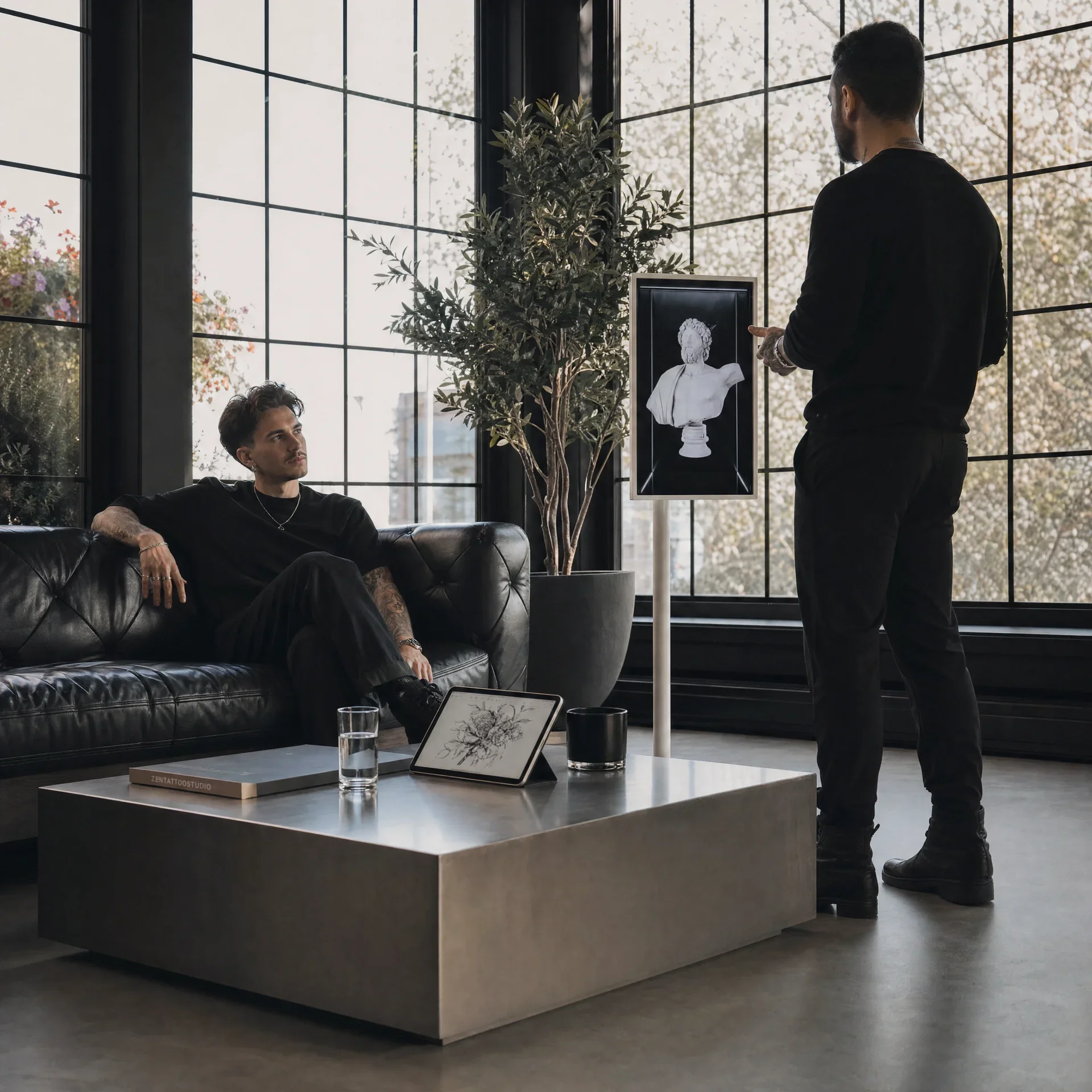
The Zen Lounge in Oakville, where in-studio consultations happen.
What a tattoo consultation is (and is not)
A tattoo consultation is the meeting where an idea becomes a plan. You bring the idea, the references, and the place on your body. The studio brings judgment about size, placement, style, and which artist should draw it. Nothing is tattooed. Nothing is signed.
It is also not the design reveal. Most custom studios, Zen included, draw the finished piece after the consultation, then review it with you before the needle starts. Expecting a finished drawing at the first meeting is a common mismatch.
Three things are easy to mix up:
- The inquiry form. You tell us the placement, the idea, your timing, and you attach references. This is how the consultation gets booked.
- The consultation. A free conversation, by phone or in the studio, about whether the idea works and who should tattoo it.
- The session. The tattoo day. You review the design, the stencil is placed, and the work starts. Our first tattoo session guide covers that day. This page stops before it.
Four things to know before you book
- It is free and it is not a commitment. You can leave without booking a date. If Zen is not the right studio for the idea, we say so and point you somewhere better.
- You do not need a finished design. A rough idea, a meaning, or a handful of screenshots is enough. Shaping it is the point of the meeting.
- You talk with an owner first, not a random chair. Austin or Dante runs the consultation and matches you to Igor, Devon, Luis, or Oxy based on the work you want.
- Pricing is discussed in the room, not on a menu. Zen does not publish a rate card. The full pricing for your project, and the session plan behind it, comes out of the consultation.
How a consultation at Zen runs, step by step
1. You send the inquiry
The consultation form asks for placement, your idea, your preferred timing, and reference images. Fill it in like you are briefing someone who has never met you. "Lion, forearm" tells us less than "lion and my daughter's birth flower, outer forearm, black and grey, I already have a half sleeve on the other arm." The team reviews it and reaches out within 24 hours, as the Plan Your Tattoo page states.
2. You pick phone or in person
The phone call is usually about 10 to 15 minutes when the decision is a quick one. If you cannot make it in and the project is big, the call simply runs longer so every idea gets walked through. The in-studio meeting is about 35 to 45 minutes and covers the process, the artists, your idea, and the design direction. Many Zen clients travel 45 minutes to three hours, so the choice is yours. If you live close and you are planning a large piece, we may suggest coming in so we can see the canvas and explain the plan visually. “An in-person consultation isn't always necessary,” says Dante, Zen Tattoo Studio. “We're extremely confident in our ability to communicate those same ideas over the phone.” The comparison table further down lays the two side by side.
3. We start with you, not the drawing
The first question is where you are coming from. “Although Zen is located in Oakville, many of our clients travel anywhere from 45 minutes to up to three hours,” says Dante, Zen Tattoo Studio. Then we get into the project, what you want to create, and your overall vision: why this tattoo, why now, what it should say, and what it should never look like. For larger pieces we explain how back-to-back sessions let us design and finish the tattoo as one cohesive project, often in fewer sessions scheduled closer together. Then the practical ones: what you already have, what you might add later, what has to stay covered at work. A tattoo that fits your life gets planned differently from one that only fits a screenshot.
4. We read your references
References are direction, not a copy order. We ask what you like in each one: the softness of the shading, the face, the composition, the contrast. We also ask what you dislike. A reference you hate is often as useful as one you love. For a deeper look at choosing a design you will still want, read how to get a tattoo design you won't regret.
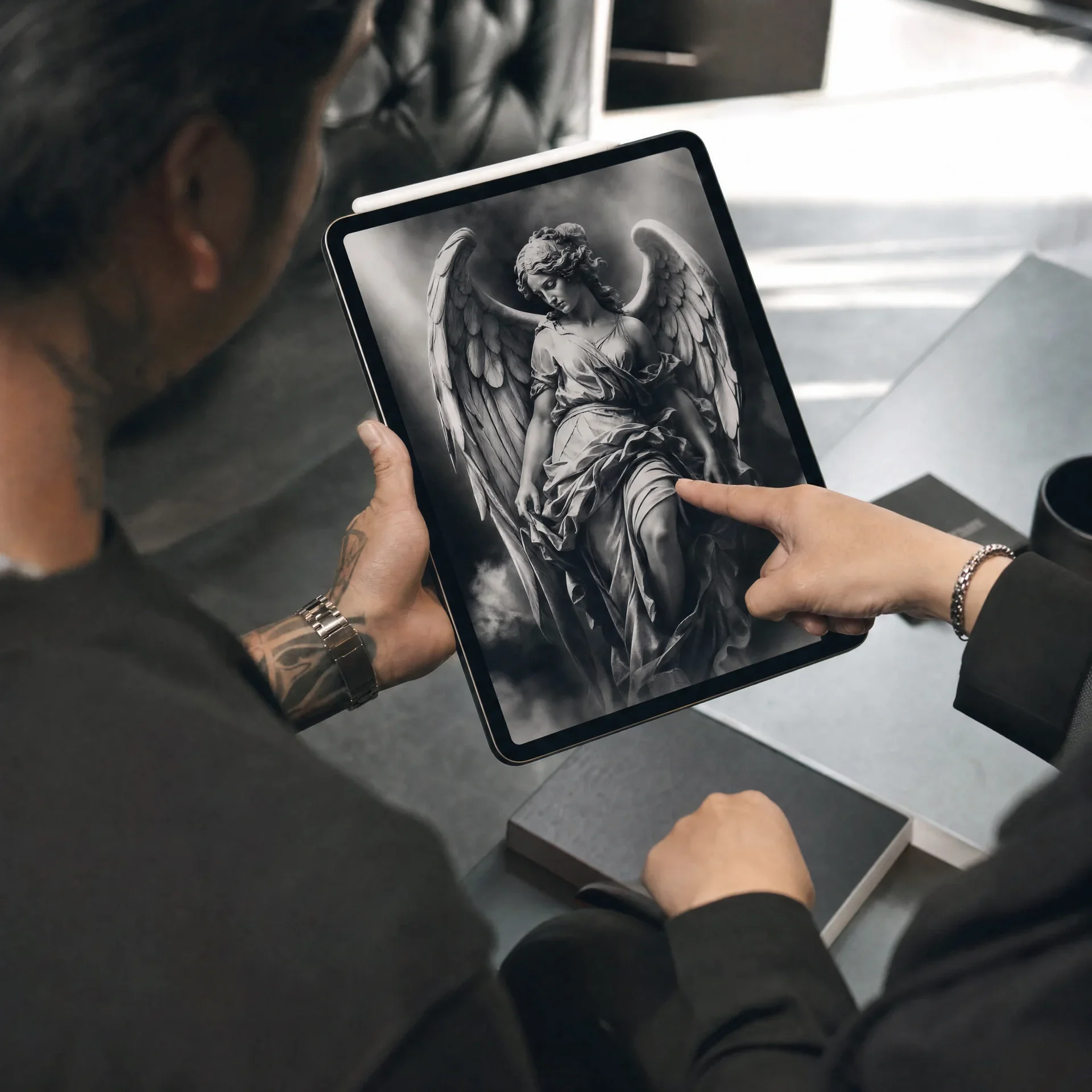
Reading references together. We ask what you like in each image, and what you do not.
5. We look at placement and size on your body
In person, this is where the meeting gets physical. We look at the area, how it moves, what ink is already nearby, and how big the piece needs to be for the detail to survive. Black-and-grey realism needs room. A portrait shrunk to fit a wrist loses the face first. If the idea and the space do not match, we will say so and offer a size or placement that works.
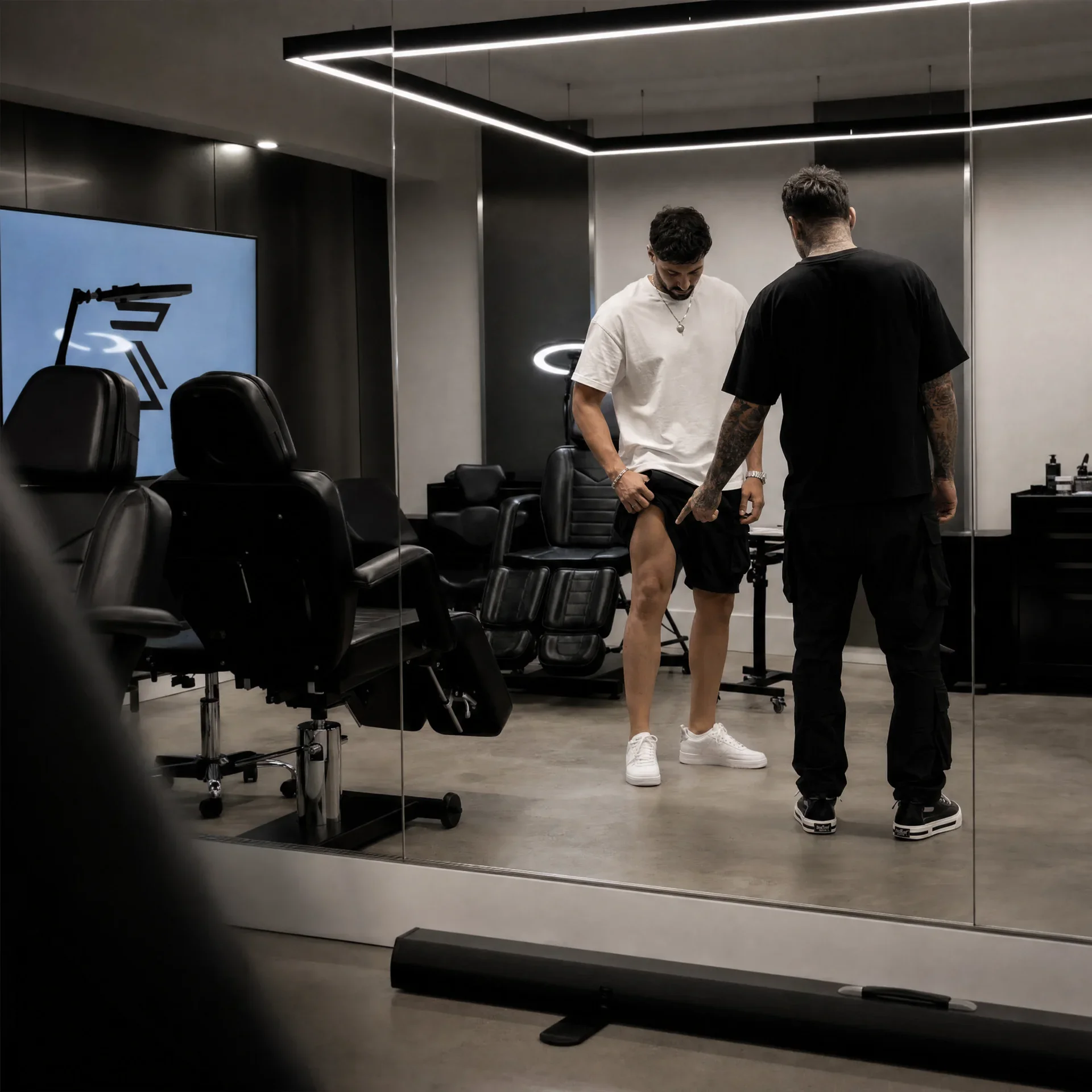
Placement and size checked on the body, in the mirror, before any design is drawn.
6. We match you to the artist
Zen is a large-scale black-and-grey realism studio. Igor Kizyma, Devon, and Luis take realism sleeves, back pieces, chest pieces, and portraits. Oxy takes fine line, flash, script, and floral. The match is made on the work, so read healed pieces on the artists page before you arrive if you can.
How do we pick between Igor, Devon, and Luis? All three work in black-and-grey realism, but each has their own themes, contrast, and how light or dark the finished tattoo reads. Our first advice is simple: look through each artist's work and notice whose pieces catch your eye. Then we guide you based on your references, the imagery you are drawn to, and healed tattoos you have seen. Fine line, florals, and calligraphy go to Oxy, our only artist in that style. “We do a really good job of matching our clients with the artist who's the best fit for their project, but the final decision is always theirs,” says Dante, Zen Tattoo Studio.
7. We plan the sessions and the price
You leave with a session timeline and the full pricing for the project. Small pieces may be one sitting. Sleeves and back pieces are several. Large projects often book months ahead, so the consultation is also where a realistic start date gets set. If you want to spread the cost, the studio offers monthly payment plans for qualifying projects.
8. You decide, then the drawing starts
If you are ready, a deposit holds your session date and comes off the final cost. The amount and the reschedule terms are on the studio FAQ page. If you want to think, think. A good studio is not in a hurry for your skin. Most clients who book pay the deposit during the phone or in-studio consultation itself, once the artist, the project, and the session dates are settled. The deposit secures those dates with your artist.
What to bring to a tattoo consultation
- 3 to 10 reference images. Include the ones you like and one or two you do not.
- The placement, and clothes that show it. A short sleeve for an arm, shorts for a leg. It is hard to plan a calf through jeans.
- Photos of tattoos you already have near the new one, and anything you want covered.
- A rough timeline. "Before summer" changes the plan. So does "no rush."
- Your questions, written down. The list below is a good start.
- Anything about your skin or health that matters. Moles, scars, skin conditions, allergies, or a medical reason to be careful with wounds. The American Academy of Dermatology suggests tattooing skin that is free of moles, because ink can hide the earliest signs of skin cancer. If a doctor has advised you about tattoos or wounds, follow that advice. This page will not overrule it.
- Clarity on the idea and what it means. “The best-prepared clients come in with a clear concept they've thought about for a while,” says Dante, Zen Tattoo Studio. Online images, healed tattoos, and personal photos all work as references.
- How many sessions you can commit to. A ballpark is enough. It shapes the whole plan.
- AI mockups, as a rough sketch only. We treat them as a visual of the direction or layout. AI does not account for readability, scale, or how a design ages on skin, so it is not a final design.
Questions worth asking at your consultation
You are interviewing the studio too. Halton Region Public Health tells people to shop around, get every question answered, and expect a good artist to answer openly and truthfully. Ask:
- Who will tattoo this, and can I see their healed work in this style?
- Does this idea work at this size and placement? What would you change, and why?
- Is this one sitting or several? Roughly how long between them?
- What is the full pricing for this project, and what could change it?
- What does a deposit hold, and what happens if I need to move the date?
- When will I see the design, and how many changes can I make on the day?
- How do you handle needles, ink, and cleaning?
- What should I do the week before the session?
Safety questions the law already answers
Some safety questions have legal answers in Ontario, so you know what good looks like before you ask.
- Single-use needles. Ontario Regulation 136/18 requires sharps used for tattooing to be sterile, single use, and from packaging that has not been opened before.
- Your contact details. The same regulation requires the studio to take your name and contact information before any service, and to explain the procedure and its risks before an invasive one like a tattoo. Expect that conversation. It is a requirement, not paperwork for its own sake.
- Inspections. Halton Region says its public health inspectors inspect personal service settings, which include tattoo studios, once a year. A disclosure sign from each visit must be posted at the main entrance. You can also request a studio's results through the region's online form or by calling 311.
If a studio cannot answer these plainly, that is your answer.
Phone call, in-studio consultation, or session day
| Compare | Phone consultation | In-studio consultation | Session day |
|---|---|---|---|
| Length at Zen | About 10 to 15 minutes | About 35 to 45 minutes | Depends on the piece |
| Who you talk with | Austin or Dante | Austin or Dante, in the Zen Lounge | Your matched artist |
| Best for | Quick decisions; clients travelling from farther away (runs longer for big projects) | Sleeves, back pieces, cover-ups, first large projects | The tattoo itself |
| Placement check | From your description and photos | On your body | Stencil on your body |
| Artist match | Recommended | Recommended | Done |
| Design | Direction agreed | Direction agreed | Design sent a week to a couple of days before (varies for Oxy); small changes in the first hour |
| Pricing | Full pricing for the project | Full pricing for the project | Already agreed |
| Cost of the meeting | Free | Free | Your quoted project |
What does not happen at a consultation
- No tattoo. Not even a small one "while you are here." The planning and the tattoo are separate on purpose.
- No pressure to book that day. If you feel rushed or guilted anywhere, that is a red flag. Our post on the biggest mistakes people make when choosing a tattoo artist explains why.
- No final drawing, usually. Custom realism takes time to draw well. You see the finished design before anything is tattooed.
- No price menu. A number given before anyone has looked at your placement, references, and existing ink is a guess.
What happens between the consultation and the session
About two weeks before your session, a member of the Zen team reaches out to talk through the overall direction and the idea behind the design. Once the direction is agreed, the design is put together. For Igor, Luis, and Devon, the team sends it to you anywhere from a week to a couple of days before the session. For Oxy, the timing varies. Any changes or revisions are discussed and made then, so the design is finalized before your first session. Changed your mind on the day? “That's not a problem whatsoever,” says Dante, Zen Tattoo Studio. “We can make those changes within the first hour before the session starts.” Only then does the stencil go on. If you are still not happy with the design on the day, Zen works with you to refine it. If it needs more time, the session is moved to the next available date so you are never rushed. If you are still not satisfied after that rescheduled appointment, Zen refunds the deposit in full. That is the Zen Design Guarantee on the booking page.
Outside that guarantee, the studio FAQ explains that deposits are non-refundable but can move to a new date with proper notice. Ask in the consultation if anything about the terms is unclear.
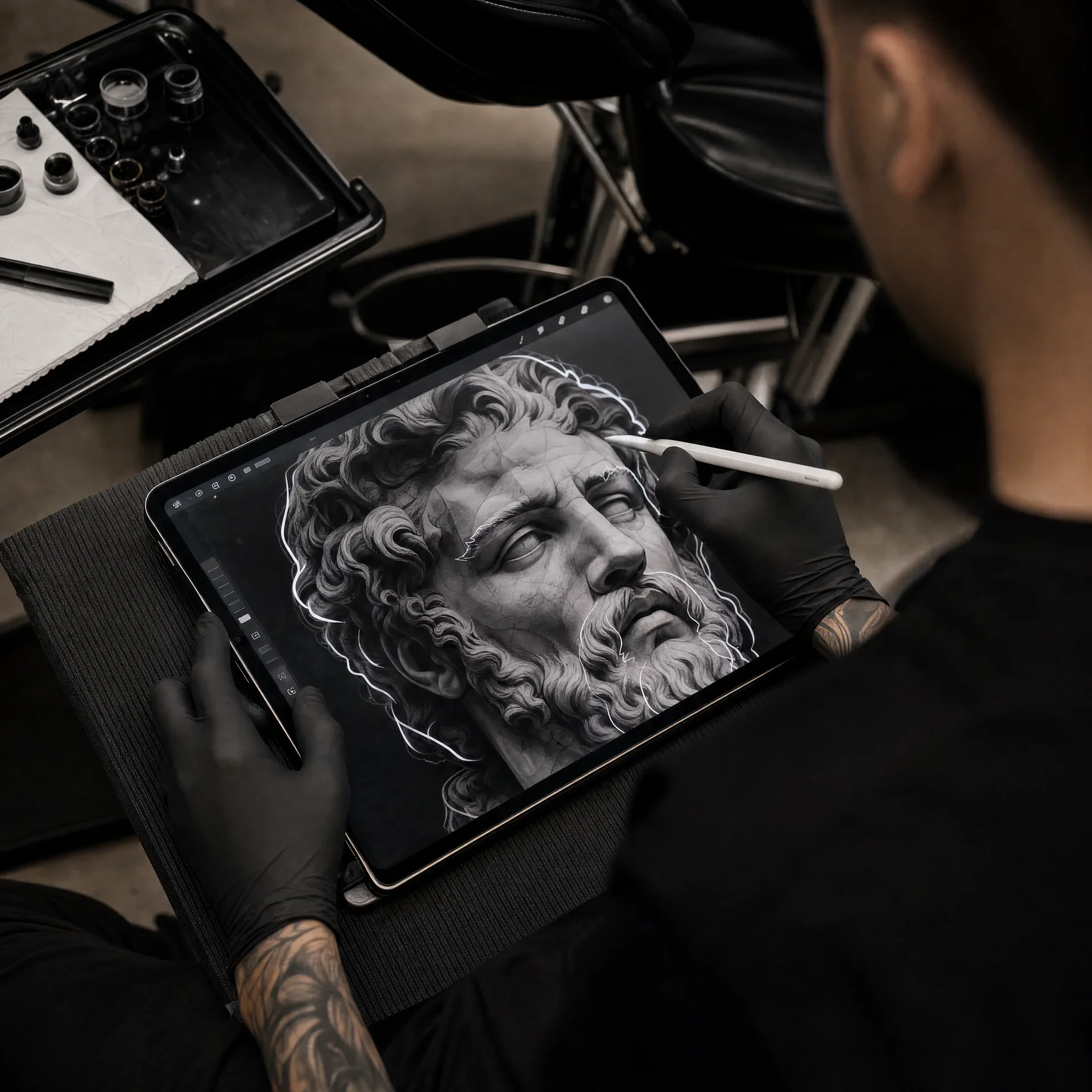
After the deposit, your artist draws the design. You see it before your session: a week to a couple of days ahead for realism, and it varies for Oxy.
Consultations for big projects and cover-ups
For a sleeve, back piece, or full body project, the consultation is a map, not a single drawing. We plan the whole area first, then the order of sessions, so the first piece does not box in the last. Our sleeve planning guide goes deeper on that.
For a cover-up, bring clear, well-lit photos of the old tattoo and be honest about what you want gone. Dark, dense ink limits what can go over it. Read what actually works for cover-ups before the meeting so the options make sense.
A consultation that changed the idea
Kirk, a longtime Zen client, came to his first consultation with no large tattoos and a plan for a full sleeve about his life story, centred on his family. His ideas felt disconnected at first: two flowers for his two daughters, something for his decades as an electrician, a link to his name, which means church, and a dragon for strength.
Talking it through turned the list into one design. The sleeve became a hybrid of Greek mythology and Japanese realism: a Zeus statue bust on the outer upper arm with electricity running through it for his trade, a cathedral window from the church he grew up in, two intertwined flowers for his daughters, and a Japanese realism dragon across most of the outer forearm. Igor tattooed it.
“It was a perfect example of what we're able to accomplish when we take the time to understand our clients and the meaning behind their ideas,” says Dante, Zen Tattoo Studio. If your ideas feel scattered, that is normal. Sorting them is what the consultation is for.
What surprises people about a consultation at Zen
Most people are surprised by how much education goes into it. You sit down with Dante or Austin, and the conversation covers your long-term goals, not only the piece in front of you. “For us, tattoos aren't transactional,” says Dante, Zen Tattoo Studio. Some clients have waited months or years for the right time, and the studio plans it that way: “When the day comes, it feels like your day, not a transaction.”
Who should book a consultation at Zen, and who should not
Book a consultation at Zen if you want black-and-grey realism, especially at scale, or fine line and floral work with Oxy, and you want the plan made before the date. It also suits first-timers who want to see the studio before they commit.
Do not book with us if you want to be tattooed the same day as the consultation, a full colour piece (Zen's realism is black and grey), or a price over text before anyone has seen the idea. You must be 18 or older to be tattooed at Zen. Seventeen-year-olds need parental consent and proper documentation. The studio is open Thursday to Tuesday and closed on Wednesdays.
How to book
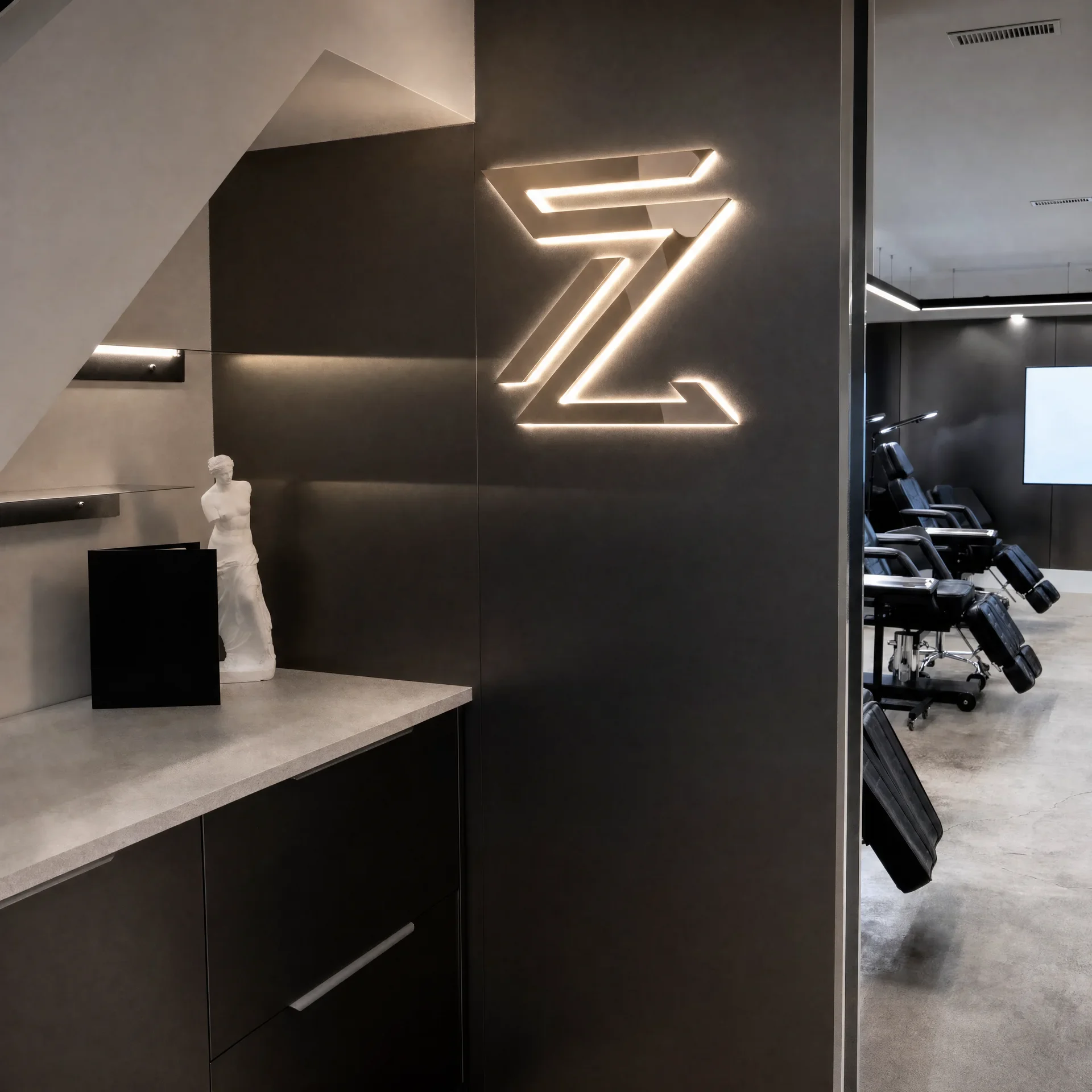
Where you arrive for an in-studio consultation at 2342 Lakeshore Rd W, Oakville.
- Go to Plan Your Tattoo and fill in the form with your placement, idea, timing, and references.
- Choose a phone call or an in-studio meeting at 2342 Lakeshore Rd W, Oakville.
- Bring the list above. Leave with an artist, a plan, and the full pricing.
Tattoo consultation FAQ
What happens at a tattoo consultation?
A tattoo consultation is a free planning conversation where your idea becomes a plan. At Zen Tattoo Studio in Oakville, co-owner Austin or Dante goes through your idea, references, placement, and size, matches you to the right artist, and outlines the session timeline and full pricing for the project. Nothing is tattooed, and you are not committed to book.
How long is a tattoo consultation at Zen Tattoo Studio?
A phone consultation at Zen Tattoo Studio in Oakville usually takes about 10 to 15 minutes, and runs longer for big projects when the client cannot come in. An in-studio consultation in the Zen Lounge takes about 35 to 45 minutes and covers the process, the artists, your idea, and the design direction.
Is a tattoo consultation free in Oakville?
Yes. Consultations at Zen Tattoo Studio in Oakville are free, whether by phone or in the studio. Booking a session afterwards is your choice. If you decide to book, a deposit holds the date and comes off the final cost.
Do I need a finished design before my tattoo consultation?
No. You do not need a finished design for a consultation at Zen Tattoo Studio in Oakville. A rough idea, a meaning, or a few reference images is enough. Shaping the idea into a design that fits your body is the purpose of the meeting.
Will I see my final tattoo design at the consultation?
Usually not. At Zen Tattoo Studio in Oakville, the consultation sets the direction, size, placement, and artist. About two weeks before the session the team talks through the design direction. For Igor, Luis, and Devon, the design is sent anywhere from a week to a couple of days before the session so revisions can be made; for Oxy, the timing varies. Small changes can still be made in the first hour of the session day.
What should I bring to a tattoo consultation?
Bring a clear idea and its meaning, 3 to 10 reference images including one or two you dislike, clothes that show the placement, photos of nearby tattoos, roughly how many sessions you can commit to, a rough timeline, and written questions. AI mockups are fine as a rough layout, not a final design. Tell Zen Tattoo Studio in Oakville about moles, scars, skin conditions, allergies, or any medical advice about wounds. The American Academy of Dermatology suggests tattooing skin that is free of moles.
Who runs the tattoo consultation at Zen Tattoo Studio?
Consultations at Zen Tattoo Studio in Oakville are run by co-owners Austin or Dante. They match you to the artist whose work fits the idea: Igor Kizyma, Devon, or Luis for black-and-grey realism, or Oxy for fine line, flash, script, and floral.
Do I have to pay a deposit at a tattoo consultation?
The consultation itself is free at Zen Tattoo Studio in Oakville. A deposit is only paid when you choose to book, usually during the consultation once the artist and session dates are set, and it is applied to the final cost. The studio FAQ explains the deposit amount and reschedule terms, and the Zen Design Guarantee refunds the deposit if you are still not satisfied with the design after a rescheduled appointment.
Phone or in-person tattoo consultation: which is better?
It is your choice at Zen Tattoo Studio in Oakville. A phone consultation takes about 10 to 15 minutes, runs longer for big projects, and suits clients travelling from farther away. An in-person consultation takes about 35 to 45 minutes and helps most when you live nearby and are planning a large piece, because the team can see the canvas and explain the plan visually.
Related reading
- What to expect during your first tattoo session. The day after the consultation, from design review to bandage.
- How to get a tattoo design you won't regret. Read it before you collect references.
- Tattoo pain chart: what hurts the most and how to prepare. Useful when you are choosing a placement.
- How to find the best tattoo studio in Toronto and the GTA. What to compare when you are shopping around.
- Our Studio. The Zen Lounge and the Tattoo Den, before you visit.
Ready? Book a free consultation at Zen Tattoo Studio in Oakville.
